

How to Choose Indoor DAS Antennas for 4G/5G Projects: A Manufacturer’s Guide
As an antenna manufacturer, we speak with system integrators, carriers, and project owners every week. One question keeps coming up: “Which indoor antenna should I use for my DAS project?” The honest answer is that it depends on your RF environment, your coverage goals, and your budget. There is no single “best” antenna—only the right antenna for your specific deployment.
This guide is written from our perspective as a manufacturer. We want to help you ask the right questions, understand the trade-offs, and avoid the common mistakes we see in RFQs and project specifications.
Start with Your Project Requirements, Not the Antenna
Before you look at any datasheet, define what your DAS actually needs to do. The antenna is only one part of the system, and its performance is shaped by the conditions around it.
Ask yourself:
Which frequency bands must be covered?
A system that only needs 4G LTE in the 1710–2700 MHz range has very different requirements from one that must support 5G NR across 600 MHz, 3.5 GHz, and 4.9 GHz.
How many carriers will share the DAS?
A single-carrier system is far less demanding than a multi-operator, multi-band deployment.
What is the maximum power per antenna port?
Low-power systems (under 5 W) behave very differently from high-power feeds (20 W or more).
How dense is the antenna layout?
A warehouse with antennas spaced 30 meters apart is not the same as an airport terminal with antennas every 10 meters.
What is the mounting environment?
Ceiling voids, corridors, open halls, and outdoor-adjacent areas each call for different antenna types.
Does the carrier or building owner specify PIM performance? If yes, that requirement immediately narrows your options.
Once you have clear answers, you can start matching antennas to the job.
Understanding PIM: When It Matters and When It Doesn’t
Passive intermodulation, or PIM, is a form of interference that occurs when RF signals pass through non-linear junctions in the antenna system. Connectors, solder points, and metal contact surfaces are common sources. When PIM products fall into the uplink band, they raise the noise floor and reduce the base station’s ability to hear the user device.
In practice, PIM shows up as shorter coverage per antenna, weaker signals at cell edges, and slower upload speeds. In shared DAS environments, one operator’s PIM can even interfere with another operator’s receive channel.
But here is what many project specs get wrong: not every DAS needs low-PIM antennas. A single-carrier system running at low power in a warehouse may never experience PIM-related problems. Specifying low-PIM antennas everywhere adds cost without adding value.
From our manufacturing experience, low-PIM antennas are most valuable when:
- Three or more frequency bands share the same DAS.
- Per-port power exceeds 20 W, or total feed power exceeds 100 W.
- Antennas are densely packed in high-traffic venues like stadiums, airports, or transit hubs.
- The system carries 5G NR traffic with 256QAM and uplink MIMO.
- The carrier contract includes PIM performance requirements.
- The project has a long service life or maintenance agreement.
- If your project is single-carrier, low-power, and covers a simple indoor space, a standard DAS antenna is often the smarter choice. It keeps costs down without sacrificing performance.
Choosing the Right Antenna Type for the Environment
Indoor DAS antennas come in several form factors, and each has a natural fit.
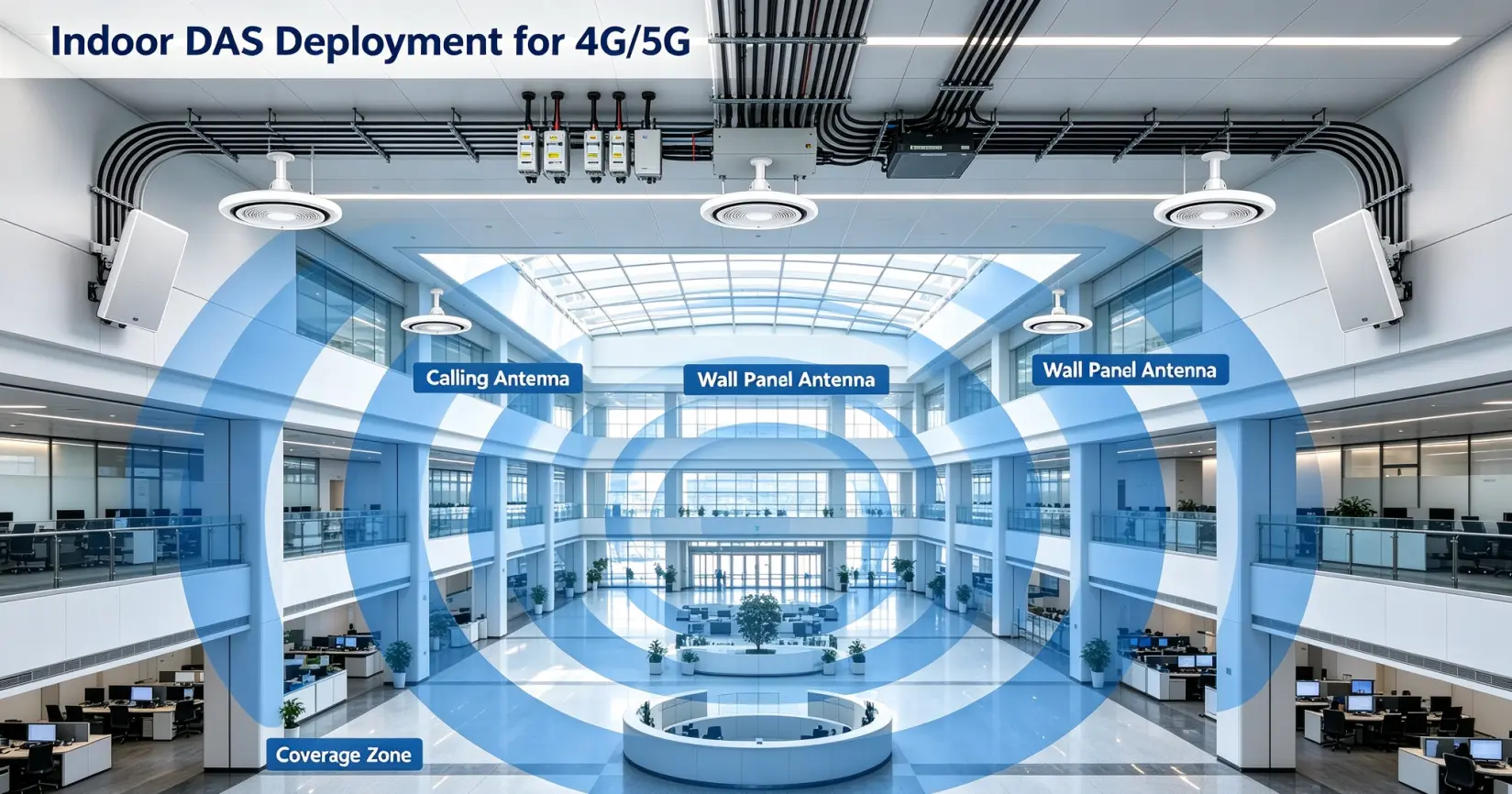
Ceiling-mount antennas are the workhorse of indoor coverage. They radiate in a broad pattern and work well in open areas like offices, shopping malls, and airport concourses. They are easy to install and blend into the ceiling environment.
Wall-mount antennas are directional or semi-directional and are used for corridors, tunnels, and perimeter coverage. They focus energy in one direction, which helps when you need to cover a long, narrow space without wasting signal.
Directional panel antennas offer higher gain and a narrower beam. They are useful for covering large open areas from a single mounting point, such as a warehouse ceiling or a stadium concourse.
Log-periodic antennas provide wideband coverage and are often used in testing or multiband applications where a single antenna must cover a very broad frequency range.
When selecting a type, consider not just the coverage shape but also the mounting constraints. Plenum-rated materials, fire-code compliance, and aesthetic requirements can all influence the final choice.
Key Specifications to Review Beyond PIM
PIM is important, but it is not the only parameter that determines success. Here is what we recommend checking on every datasheet.
| Why It Matters | |
|---|---|
| Frequency range | Must cover every band in your DAS plan. A missing band means extra hardware later. |
| Port count | 4×4 MIMO supports higher 5G throughput than 2×2. It also affects isolation and cabling. |
| Polarization | Horizontal, vertical, or ±45° dual-polarized. Must match your head-end and cabling. |
| Gain | Higher gain extends coverage but narrows the beam. Balance against spacing and mounting height. |
| Beamwidth | Determines the coverage footprint. Wider covers more area; narrower concentrates signal. |
| VSWR | Lower VSWR means better impedance matching and less reflected power. |
| PIM rating and test conditions | Always check the dBc value, test power, and test method together. |
| Port-to-port isolation | Critical for MIMO. Poor isolation degrades performance and can cause interference. |
| Connector type | 4.3-10 is the current standard for low-PIM DAS. Confirm compatibility with your jumpers. |
| Mounting and dimensions | Ceiling for open areas, wall-mount for corridors. Check fire-code and plenum requirements. |
| IP rating and temperature range | Indoor-only vs. indoor/outdoor. Extreme temperatures affect long-term PIM stability. |
| Maximum input power | Must exceed planned per-port power with margin to avoid thermal damage and PIM drift. |
How to Work with a Manufacturer on Your RFQ
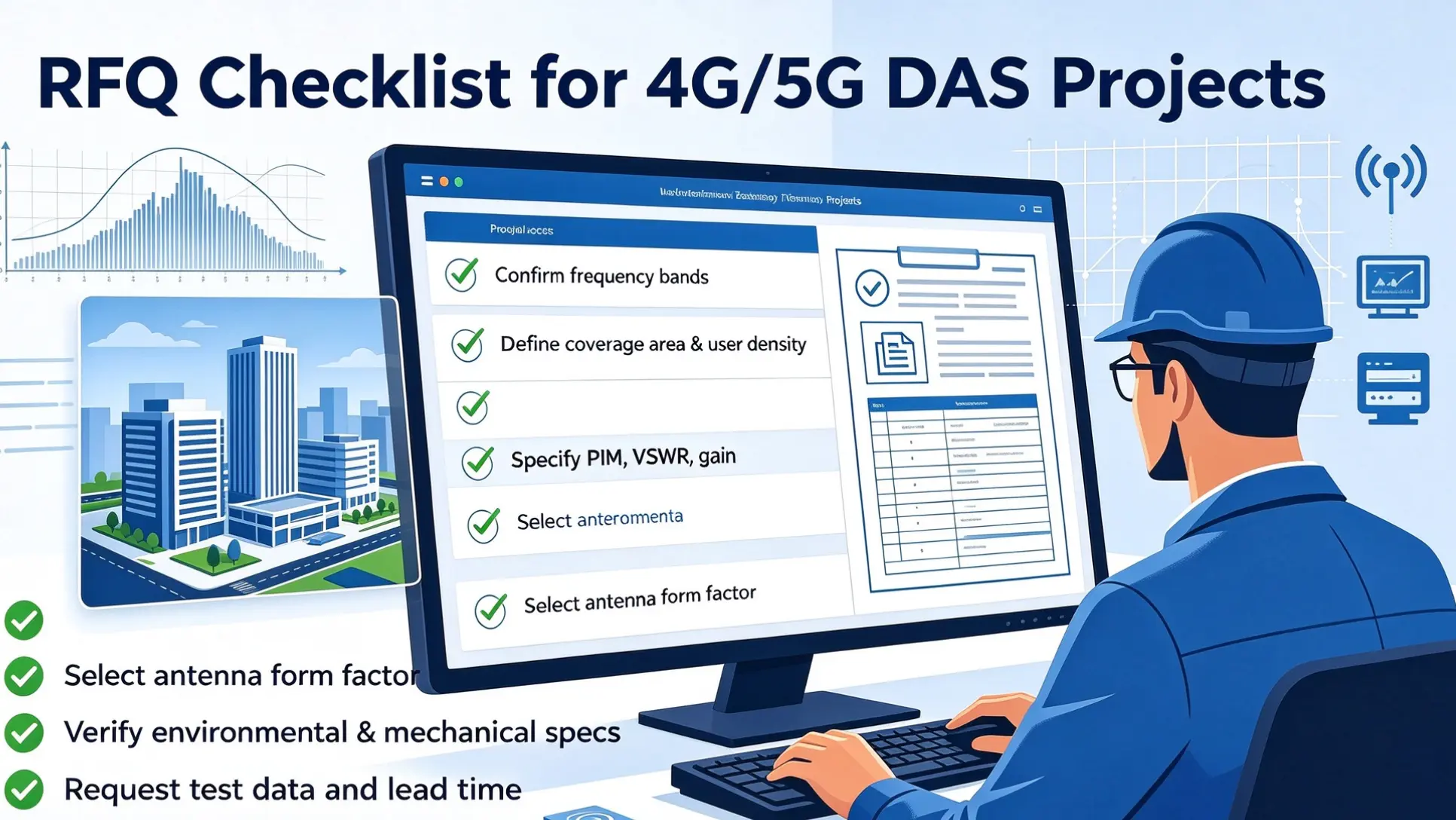
A well-prepared RFQ saves time and ensures you get comparable quotes. As a manufacturer, we appreciate customers who include the following details:
- Full band plan and target frequency ranges
- Port count and MIMO configuration
- Polarization requirement
- PIM requirement: dBc value, test power (e.g., 2×43 dBm), and test method
- Gain and beamwidth targets per band
- VSWR requirement
- Connector type
- Mounting type and environment
- IP rating and operating temperature range
- Estimated project quantity and annual volume
- OEM/ODM or private-label needs
- Delivery timeline and shipping destination
- Any carrier approval or regulatory requirements
When you specify PIM test power and method, every supplier quotes on the same basis. That makes comparison fair and avoids surprises later.
Testing and Acceptance: Don’t Skip This Step
Even the best antenna can underperform if the installation is poor. We always recommend that customers include on-site PIM testing in their acceptance procedure.
Factory PIM testing, following standards like IEC 62037, confirms the antenna’s quality as a manufactured component. On-site testing confirms the quality of the installation, including connector torque, cable routing, and mounting hardware. Both matter. If you are commissioning a DAS, plan for PIM sweeps after installation. It is far easier to fix a connector issue during commissioning than after the network is live.
How Weibonuo Antenna Can Help ?
Weibonuo Antenna designs and manufactures indoor DAS antennas for 4G and 5G projects. We work with system integrators, carriers, and building owners around the world, and we understand that every project has its own constraints.
Whether you need standard ceiling and wall-mount antennas, low-PIM models for multi-carrier deployments, or a fully custom design for a specific band plan, we can support you from RF simulation through volume production. Our team can also help you review your specifications and choose the right antenna for your environment.
If you are working on an indoor DAS project and need guidance, send us your requirements. We will help you find the right solution. Contact Weibonuo Antenna today for datasheets, custom design support, or a project quotation.